Consumer Product · Web App · 2026
The Philosophy Machine
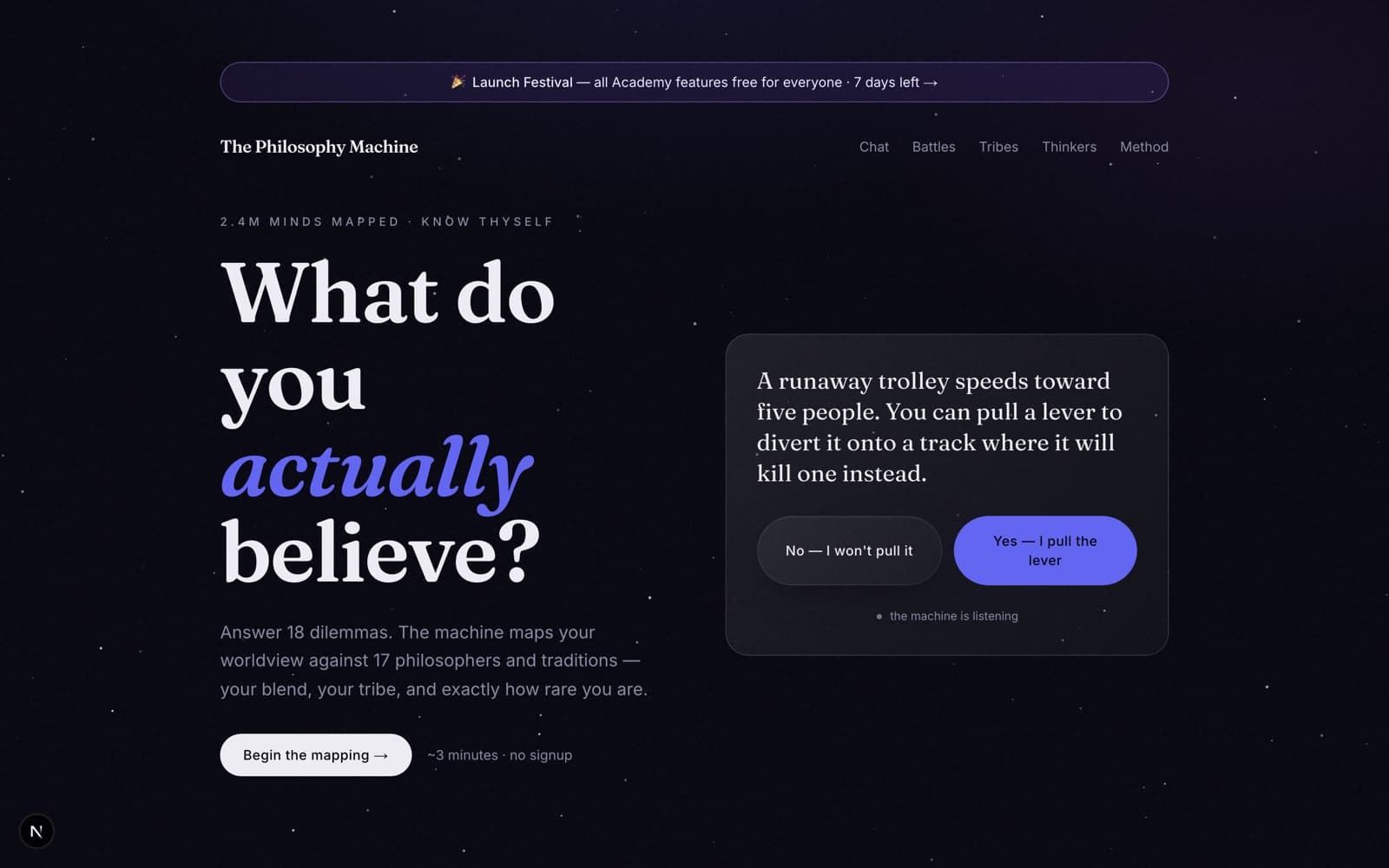
The Philosophy Machine is a consumer web app that answers a question people genuinely want answered: what do I actually believe? You work through 18 moral dilemmas, and the machine maps your worldview against 17 philosophers and traditions, returning your blend, your tribe, how rare you are, and a share card built to travel.
18
genuine moral dilemmas, no filler questions
17
philosophers and traditions mapped
~3 min
to a result, with no signup required
Shareable
result cards built as the growth loop
Capabilities and figures reflect what was designed and shipped; any numbers shown appear on the live product.
01 — The Problem
The Problem
Philosophy is one of the most interesting things humans have ever done, and almost nobody engages with it after school, because the entry points are dense books or shallow quizzes. The product had to sit in the gap: intellectually honest enough that a philosophy graduate respects the result, and immediate enough that a stranger finishes it in three minutes and sends it to a friend.
02 — Research
Research
The mechanics that make products like this spread are well understood: an identity-revealing result, a strong visual artefact to share, social comparison, and a reason to return. The hard part is bolting those onto content with real depth, rather than the usual empty personality quiz. So the dilemmas had to be genuine philosophical problems with no comfortable answer.
03 — Planning
Planning
The core loop came first: dilemmas, scoring, result, share card. Everything else, the tribes, the rarity score, comparing with friends, chatting with your philosopher, the battles and the daily dilemma, exists to deepen the loop or to bring people back, and each was built only once the core felt genuinely good.
04 — Design
Design
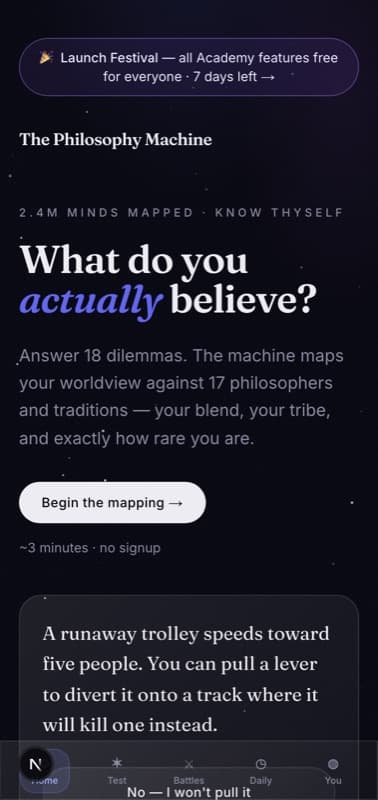
The production value is the point. A dark, cosmic, serif-led interface signals seriousness rather than quiz-site frivolity, while the pacing keeps it light. The dilemmas are presented one at a time with real weight, and the result screen is designed to be screenshotted, because a share card is the product's distribution.
05 — Development
Development
Built with Next.js and TypeScript on Prisma and a relational database, holding the philosopher models, the scoring, user results, tribes and rarity calculations. Results are computed live, and the share cards are generated as images so they render properly wherever they are posted.
Engineering
Challenges worth mentioning.
Challenge
Making the result intellectually credible rather than the arbitrary output of a personality quiz.
Solution
The scoring maps genuine dilemmas onto the real positions of 17 philosophers and traditions, so the blend you receive reflects the actual structure of your answers and holds up to scrutiny.
Challenge
A quiz is played once and forgotten, which is fatal for a consumer product.
Solution
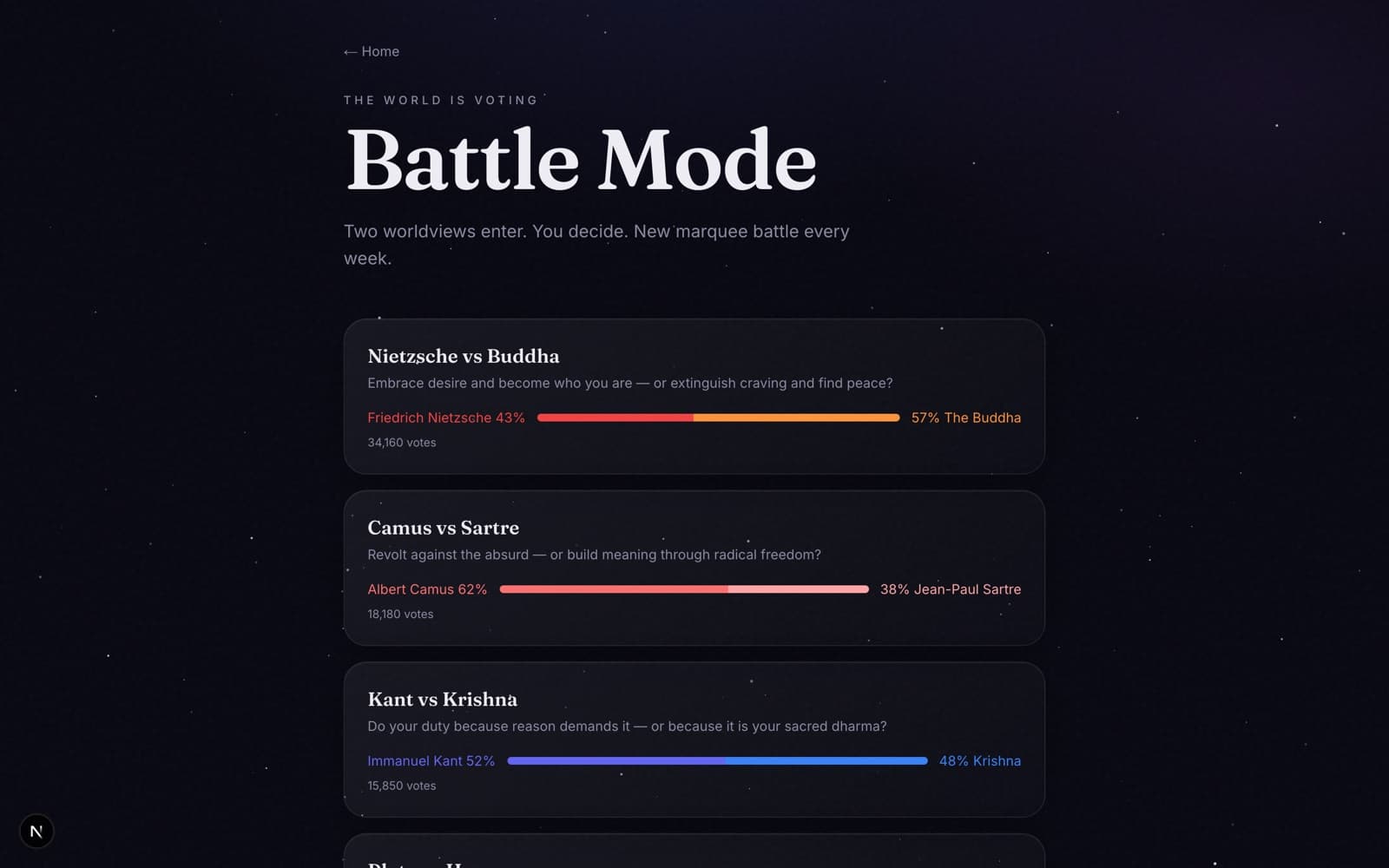
Rarity, tribes, friend comparison, philosopher battles and a daily dilemma turn a one-time result into something people return to and argue about.
Gallery
Across every screen.
Business Outcome
The Philosophy Machine turns real philosophy into something people voluntarily spend three minutes on and then send to their friends. It proves the studio can build not just business software but consumer products with the production value and mechanics needed to actually spread.
More Work
Other projects.
Final note
Facing a similar problem?
If any part of this case study sounded familiar, a discovery call is the fastest way to find out what a solution would look like for your business.
Projects from $600₹25,000HK$5,000NT$19,000 · Response within one business day · Free website audit